
What is Pre-Approval?
If you are looking to purchase a property (such as a home, vacation home, condominium, investment property) in order to have a realtor take your offer seriously, you need to get pre-approved for a loan. You need to be able to show that you can afford the purchase price and the mortgage payment, that you have the down payment and will qualify for the needed loan amount.
Pre-approval is getting an underwriting approval for the borrower that is substantiated by your credit report, income documentation, and asset documentation up to a purchase price amount for specific property types such as single family residence (SFR), duplex, triplex, and fourplex in residential lending.
A pre-approval is not a commitment to lend. Final approval depends on a satisfactory appraisal, title, verification of all information, and final underwriting review.
Why Get Pre-Approved?
Once a borrower is pre-approved, realtors will take your offer seriously. A pre-approval letter is the lynchpin — an actual document to show that you can get the loan needed to complete the sale.
Pre-Approved vs. Pre-Qualified
Being Pre-Qualified For a Loan Is Not Enough
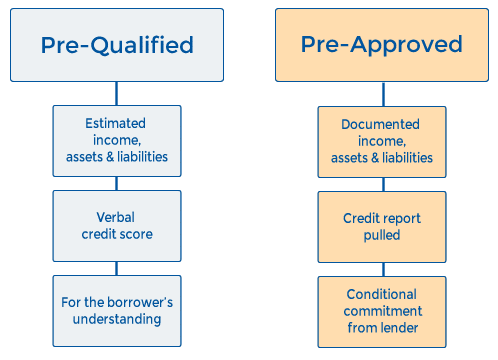
Pre-qualification is simply a loan agent’s opinion, a verbal assessment of your potential ability to obtain a loan based on a conversation. To get pre-qualified, you may have even filled out an application for a loan, but your data has not been verified by substantiated paperwork.
In contrast, pre-approval is substantiated by a credit report, income documentation, and asset documentation.
Getting pre-qualified is fine when you are thinking about buying a property, as a first step for your own information, to understand what you can afford. But it’s not what realtors want to see when you turn in an offer. They want the borrower to have applied, provided the supporting paperwork to have their data validated by an underwriting process and personally verified by a mortgage lending professional, i.e. me.
How to Get Pre-Approved
How We Get You Pre-Approved
The pre-approval process is similar to applying for a loan. I will collect your data and verify your supporting documents, just like a loan application. This data includes:
- Social security number (collected through my secure application portal).
- Proof of employment
- Proof of income
- Tax documents
- Current Residence
- Bank information
- Credit information
We use an automated underwriting system that allows me to enter these data points. From that, I can estimate the purchase price range you may qualify for, the down payment you may need, and the loan amount you may be able to obtain.
FAQs About Pre-Approval
Will applying for pre-approval lower my credit score?
Many people worry about how having your credit run affects their score. The good news is that we can start your pre-approval with a soft credit check, which has no impact on your score. We can run the automated underwriting system (AUS) for your pre-approval with a soft pull. When it’s time to submit your loan for formal underwriting approval, we will need to do a hard credit check.
Hard checks occur when you apply for a mortgage or auto loan. Credit card applications, student loans, personal loans, and apartment rental applications also trigger hard checks. In general, a hard credit check can lower your score slightly. Because of this, I work to limit the number of times your credit is pulled.
However, your credit can be checked multiple times for a single purpose (i.e., applying multiple times for a car loan) within a 30+ day window, and that only counts as one incidence.
Note: A “soft check” is when you check your own credit, when we run a preliminary pre-approval for you, or when a potential employer accesses your credit profile as part of a background check.
What is a mortgage loan originator?
A mortgage loan originator, or MLO, is an individual who takes a residential mortgage loan application and offers or negotiates loan terms for compensation. MLOs are also called loan officers. An MLO works with the borrower from the initial consultation and application through approval and closing, and must be licensed and registered through the NMLS. You can look up any originator, including Vic (NMLS #244388), at nmlsconsumeraccess.org.
What is a Mortgage Consultant?
Mortgage consultants are finance professionals who help people buy homes and investment properties with financing that fits their circumstances. The consultant’s relationship with buyers includes:
- helping buyers understand the rules and guidelines of mortgage lending
- presenting buyers with realistic buying options
- advising them on making a choice that fits their needs and financial resources
Knowledge: In general, the mortgage consultant needs in-depth knowledge about the mortgage industry, enabling them to:
- provide accurate current mortgage rate and product information to buyers
- communicate effectively with lenders
- help clients get approved by knowing each lender’s guidelines
- manage loan documents, the loan process, and closing
Skills: A good mortgage consultant will excel and make their clients happy if they have skills in all of these areas:
- Communication — the ability to listen to clients, understand their needs, and explain mortgage details clearly
- Social — empathy and respect for clients during stressful transactions
- Math — the ability to compile complicated data and interpret it to compare loan offerings
- Detail — accurately tracking calculations and statuses for many clients concurrently
- Decision-making — using reason and experience to help clients choose an option they will be happy with
- Desire for mutual success — using their experience and skills to help a client close on a loan
What is a loan officer?
A loan officer is another name for a mortgage loan originator (MLO). Loan officers may work for banks, credit unions, or mortgage companies. A loan officer at a bank or credit union can offer only the programs and rates that institution makes available. A loan officer who works with many lenders can compare programs and rates across those lenders for you.
How long is a pre-approval letter good for?
A pre-approval is typically good for 90 to 120 days, depending on the lender. That is the window in which your credit report is still considered current. After that, your credit may need to be pulled again.
I have hands-on relationship with my clients. I stay in communication with you, and I will check in with you throughout the period of time that you are looking for a property. If you tell me your data hasn’t changed, and you can provide updated documentation supporting reported income and assets, I will keep issuing a pre-approval letter until you get into contract. We may need to re-run your credit after the 90 days has expired, but not always.
How are independent brokers different from banks?
Independent mortgage brokers like me are motivated in a different way. We build a relationship with you. I help you get into the position you need to be to buy the property you want. I have a vested interest in your success, and I hold your hand along the way. I shepherd the process through from start to finish, with care.
Why Straight Deal Mortgage Is Different from Big Banks

My Business Is All About Relationships
One reason I fund loans as a correspondent lender is that I control the timeline and the appraisal, while still shopping every loan against a broad wholesale panel. Strong investor and underwriting relationships help me move quickly and solve problems without putting every borrower through a bank’s assembly line.
My reputation is built on knowing the loan and underwriting process in depth, communicating directly with the people responsible for the file, and advocating for a well-supported approval.
Our job is not only to go over your stats and specification prior to even submitting a loan packet so that we eliminate the potential of problems down the line, but also to find solutions when problems arise in underwriting. If your numbers or paperwork are not initially issue-free, there may yet be ways of obtaining your loan, by whom we choose for your application, by how we present your information to the lender, and/or by providing other, less-traditional supporting documentation.
We have your back!